I don't have optimal soil or sun conditions, and a really full garden, so my space for a veggie bed is limited. A few years ago, I started growing vegetables in containers, sneaking them into sunny spots between perennials and shrubs, here and there throughout the garden. I've discovered many vegetables grow well in containers--tomatoes, peppers, zucchini, eggplant, carrots, beets, turnips, squash, and even potatoes. Actually, especially potatoes! Here's how to do it.
First you need potatoes, ideally small ones which are better suited to the confined space of a container. I select smaller varieties and grow them to maturity (harvesting about a week after the foliage has died back). Another option is to grow full-size potatoes but harvest them early as baby potatoes before they reach full size (about a week or two after flowers form).
Last year I grew 'Bintje' (above). This year I'm growing 'German Butterball,' 'Purple Peruvian,' and 'Red Norland,' all purchased as seed potatoes (the first three from Landreth, the latter from locally-owned Downtown Home and Garden).
Seed potatoes are not actual seeds; they're mature potatoes that we cut up and plant. If you get your seed potatoes a month or so before planting, store them in a cool, dry, dark place at about 50 degrees. (If you're storing potatoes throughout the winter, requirements are different. I'll write about that in fall.)
Some people purposefully wait for their seed potatoes to sprout before planting them. This is called chitting and is achieved by storing the potatoes in a dry place at room temperature a week or two before planting. Chitting shortens the amount of time it takes the potatoes to sprout and mature. Some of my potatoes chitted accidentally because my storage area wasn't cool enough. I found it a bit difficult to handle and cut the potatoes without breaking off some of the sprouts.
Whether or not your eyes have sprouted, cut the seed potatoes into pieces so there are three eyes (or buds) per piece. Note: Dark potatoes like this 'Purple Peruvian' will stain your fingers, but it washes off easily.
You can use any large container, provided you drill drainage holes into the bottom. I use plastic storage bins because they're lightweight and inexpensive. They're on sale now for back to school and will be again after the holidays. I got the one shown here at a big box for $4 after Christmas.
My bin is 18" deep, 18" wide, and 25" long, and I wouldn't go any smaller than that, especially not in depth. I drilled holes (7/32" bit) along the bottom edges and in parallel rows, lengthwise. You do not need the lid. I move mine around the garden as a weed suppressant.:)
For filler, I like a 70/30 combo of compost and a good soil mix. The City of Ann Arbor gives out free compost in spring, so I load up there. You can adjust the ratio for your own needs. Potatoes don't need rich soil, but I think they grow much better in a container with it.
Fill your container about a third with your soil/compost mix. Plant each potato piece so it's sitting about an inch from the bottom of the tub and is covered in the rest of the soil. Plant so a cut edge is facing down and the eyes are facing up. I want to tell you I planted the pieces 6 inches apart, but it was likely more like 3 inches. I varied the planting depth a little, to create more space.
Potatoes like full sun, so if you have it, great! If you don't, don't worry. Potatoes are forgiving. Once my trees leaf out, my bin only gets four to six hours of a sun a day and the potatoes did fine.
Here is the bin with the potato pieces planted. This year, I also planted in a potato sack, which my mother wasn't using. The instructions are the same, except you don't need to drill holes because the material is porous, and not as many potatoes fit into it. Otherwise, results were the same.
In-ground potatoes can be planted when soil temperatures reach 45F. I plant mine in the bins at the end of April here is southeastern Michigan, where the last frost date is mid-May.
I water my potatoes once a day, like I would any container. Don't worry if your potatoes don't grow evenly at first. The shorter foliage will catch up in a few weeks.
The heights have evened out now at about 8 inches tall. At this stage, you want to add more soil into the bin, which is the same concept as mounding soil around a plant growing in the ground. Add about 2 inches of soil mix, being careful not to break the stalks.
As the potato stalks grow, keep adding more soil into the bin in stages. This is not an exact science; I add 2 inches each time the foliage gets to be about 8 inches over the soil line. When you've added enough soil to be about 2 inches from the top of the bin, stop filling it. You need at least that amount of clearance so that water has a place to collect without overflowing in heavy rainfalls.
Eventually the potatoes flower (these are 'Peruvian Purple'), bees pollinate, and the potatoes grow.
After about three months, you'll notice that much foliage is still growing, but some has died back. Potatoes are ready to harvest a week or two after the foliage is dried out!
Carefully dig in the areas where foliage has died, leaving the remaining stalks intact. There's nothing I like more than sticking my arm elbow deep in warm earthy compost and rooting around for potatoes. And it's so much easier than digging.
Ta da! My first potato of 2011, a 'Red Norland,' harvested on July 27. They are so good eaten right after harvesting--I ate this one raw, like an apple.
I'm going to do a second planting in the next few days, as soon as I harvest everything currently in the bin. I'm not sure if there's enough time for a second harvest, but I'm going to see what happens. Three months from now will be Halloween. Since potatoes can handle some cold, I'm hoping they will finish by then. I'll let you know.
Another advantage to growing in a bin is you don't have to worry about crop rotation. I dump the compost/soil mix onto my veggie bed at the end of the season, wash the container with a solution of 9 parts water to 1 part bleach, and fill it with fresh soil next year. I can use the same container over and over again, and I save some potatoes to start next year, too.
Showing posts with label cheap. Show all posts
Monday, August 1, 2011
Saturday, February 12, 2011
Seedy Saturday Swap
There are few things I love as much as seeds. They come in so many wonderful shapes, sizes, colors, and textures, and produce such a wonderful variety and bounty of food and blooms. Each from just one tiny little kernel! Some people may fantasize about rolling around in a big ole pile of money, but I say ptui! I'd much rather roll around in a mountain of seeds. (Or leaves. Or chocolate. But not grubby money. Bleck!)
So I was very excited today to attend the Project Grow seed swap held at Downtown Home and Garden.
Here's the loot from the swap. You'll have to take my word when I tell you I contributed at least twice as many seeds as I took, and that I plan to share the wealth at future swaps!
Yep, people just love talking about seeds, especially in winter.
I'm really excited to try something called orach, which supposedly tastes like spinach but gets kind of viney, and a bunch of new-to-me heirloom tomatoes: 'Blondkopchen,'* 'Costoluto Genovese,' 'Coyote,' 'Garden Peach,' 'Little Lucky,' 'Pink Accordion,' 'Riesentraube,' and 'Tiger Tom.' Also scored some fennel and four o'clocks seeds.
I may also have purchased some heirloom tomato seeds from Project Grow, of varieties I tasted last summer at their tomato tasting: 'Snow White' and 'Brown Berry' cherries and 'Mrs. Benson' beefsteak.
I've grown over 15 varieties of heirloom tomatoes in each of the last two years and swore to myself (swore—you gotta go with your strengths, I guess) that, for a variety of reasons, I would grow no more than 8 varieties this year. Ha ha ha ha ha! The best laid plans and all that. 'Cause the list above doesn't even include my favorites 'Tiger-Like,' 'Japanese Black Trifele,' and 'Gajo de Melon' or the 'Black from Tula' and 'Dr. Wyches Yellow' (plus a purple tomatillo) from the lovely proprietor of the Populuxe Seed Bank.
I guess it's high time I start winter sowing this season!
I was also excited that there was free food! Downtown Home and Garden owner Mark Hodesh cooked up eggs, any style, on this wonderful 1930s stove. (Note to self: Always take more than one photo so people don't have their eyes shut. Oops. The management has been notified.)
Nommy! Soft-boiled eggs and toasted Zingerman's bread--all free! My dad and I loved eating our eggs this way, dipping the toast into the ooey, gooey yellow center. The fact that my mom thought this technique bordered somewhere between barbarian and childish only egged (ha ha) us on.
I enjoyed the sunny, seedy swap so much, it prompted a second post in under a week.
Hugs, ya'll!
*Seed originated from the Gatersleben Seed Bank in the former East Germany, for my #seedchat friends.
So I was very excited today to attend the Project Grow seed swap held at Downtown Home and Garden.
Here's the loot from the swap. You'll have to take my word when I tell you I contributed at least twice as many seeds as I took, and that I plan to share the wealth at future swaps!
Yep, people just love talking about seeds, especially in winter.I'm really excited to try something called orach, which supposedly tastes like spinach but gets kind of viney, and a bunch of new-to-me heirloom tomatoes: 'Blondkopchen,'* 'Costoluto Genovese,' 'Coyote,' 'Garden Peach,' 'Little Lucky,' 'Pink Accordion,' 'Riesentraube,' and 'Tiger Tom.' Also scored some fennel and four o'clocks seeds.
I may also have purchased some heirloom tomato seeds from Project Grow, of varieties I tasted last summer at their tomato tasting: 'Snow White' and 'Brown Berry' cherries and 'Mrs. Benson' beefsteak.
I've grown over 15 varieties of heirloom tomatoes in each of the last two years and swore to myself (swore—you gotta go with your strengths, I guess) that, for a variety of reasons, I would grow no more than 8 varieties this year. Ha ha ha ha ha! The best laid plans and all that. 'Cause the list above doesn't even include my favorites 'Tiger-Like,' 'Japanese Black Trifele,' and 'Gajo de Melon' or the 'Black from Tula' and 'Dr. Wyches Yellow' (plus a purple tomatillo) from the lovely proprietor of the Populuxe Seed Bank.
I guess it's high time I start winter sowing this season!
I was also excited that there was free food! Downtown Home and Garden owner Mark Hodesh cooked up eggs, any style, on this wonderful 1930s stove. (Note to self: Always take more than one photo so people don't have their eyes shut. Oops. The management has been notified.)
Nommy! Soft-boiled eggs and toasted Zingerman's bread--all free! My dad and I loved eating our eggs this way, dipping the toast into the ooey, gooey yellow center. The fact that my mom thought this technique bordered somewhere between barbarian and childish only egged (ha ha) us on.I enjoyed the sunny, seedy swap so much, it prompted a second post in under a week.
Hugs, ya'll!
*Seed originated from the Gatersleben Seed Bank in the former East Germany, for my #seedchat friends.
Monday, March 22, 2010
Pinky Rabbit
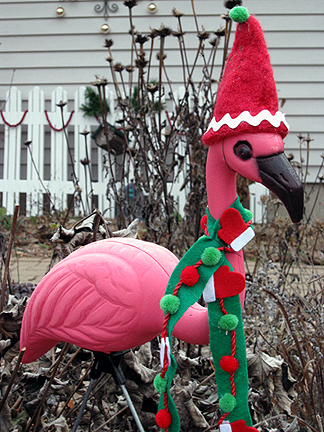
Hippity hoppity, Easter's on its way. I know because my pink flamingo finally got its rabbit ears.Yes, we're livin' large here at Garden Faerie's Musings.
Back in early December, I managed to find a Santa hat (purchased as an ornament for 25¢ at the Ann Arbor ReUse Center), and to make a scarf from random scraps, for Pinky, the pink flamingo that graces my front yard.Since I'm not very crafty, I was rather pleased with myself.
[Gertrude and Siegfried, the backyard pink flamingo pair, have a more delicate constitution and overwinter in my basement. But Pinky's a self-sufficient old dame who can fend for herself. (Remind you of anyone?) Well, except that she has to put up with ludicrous outfits.]
For St. Patrick's Day, I removed the hat and turned the scarf around so it was green.
Today I went back to the ReUse Center and found this homemade magnet for 25¢. And hey bang presto, nothing up my sleeve! five minutes later I had turned it into the rabbit ears above.I'm really pleased with how that turned out, too. The photo tickles me no end.
I've said it before, and I'll say it again, pink flamingos really add a touch of class to the garden.
Breaking News: For immediate release. For the first time in 40 years, against all odds, not one, but two (2) Lindt chocolate rabbits have survived unscathed in the home of the Garden Faerie for well over a month now. A well-known chocoholic famous for finishing multiple chocolate rabbits well before Easter, the Garden Faerie is as dumbfounded as the rest of us about the origin of her new-found will power. "A dark chocolate one (not shown) is for my mom, but for me an Easter rabbit has to be milk chocolate (pictured)," the Faerie was quoted as saying by a neighbor, who saw her clutching the rabbits and muttering quietly to herself. We have confirmed reports that the sugar-free Peeps are long since gone.
Monday, March 1, 2010
March Mish-Mash Monday
Today I'm mish-mashing about a book giveaway, backyard wildlife, wisteria pruning, and my buckthorn song.
Book Giveaway:
Fun with Winter Seed Sowing
Jane Marie, a fellow Michigan garden blogger at Thyme for Herbs, recently contacted me to see if I would donate a copy of my little book, Fun with Winter Seed Sowing, for a giveaway she wanted to host. Well, of course I was interested, and she quickly got a post together. For details and to enter, just stop by Jane's post, Book Giveaway - Winter Seed Sowing. You have until midnight on Friday, March 5th to enter.
Cooper Trouper (Earworm for ABBA Fans!)
I've been having new wildlife visitors this winter. The other day, I spied with my little eyes what I believe to be a Cooper's hawk sitting on my utility wires. I didn't get a good look because I rushed to get my camera right away.
The hawk saw me approach the window, so this is the photo I got. (Sorry for the grainy quality; it's max telephoto through a thick glass door.)
A few minutes later, the hawk had perched on a tree limb, even farther away. This is the best shot I could get. I used to see Cooper's hawks more frequently two houses ago, where I lived in a more open area. This is the first time (in nearly 8 years) I've seen a hawk at my current location. No other birds or squirrels were languishing at the feeders during the hawk's short visit.
Pruning Wisteria
On Thursday, in about a foot of snow, a few intrepid volunteers and I joined Kathy Squiers of Washtenaw County Parks and Recreation to do a little pruning at County Farm Park in Ann Arbor. I don't mind the snow at all and I try to earn most of my master gardener volunteer hours in the off season, so I can spend gardening months in my own garden! The main task was pruning a very overgrown wisteria, which had never bloomed.
The most commonly planted wisterias are Wisteria sinensis (Chinese wisteria) and Wisteria floribunda (Japanese wisteria). It was uncertain which kind is planted at County Farm Park. There's also American wisteria, Wisteria frutescens, which is native to the eastern half of the U.S., including Michigan. That's the one I'd grow, if I had enough sun or something sturdy enough for it to grow on.
Wisteria is a climbing vine that can reach 60 feet. Its base twists around its support (trellis, arbor, house) and then spreads outward. Wisteria grows quickly and can get quite heavy and large over time, sometimes overpowering its support.
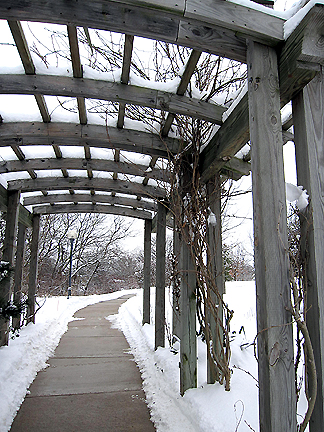
This arbor is plenty strong, but the wisterias had too many competing main vines (or trunks)...
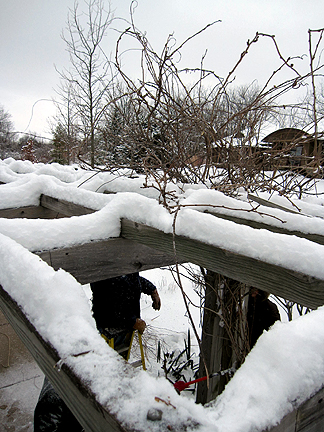
...and way too much tangled, or as A Chef in the Garden so aptly put it, Medusa-like top growth.
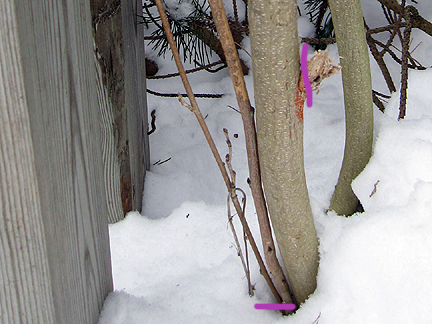
We started by removing thinner vines that were competing with the main vines (those shown with the horizontal fuchsia mark above), using saws or loppers. If a weaker wine was wrapped around a stronger one, we got rid of that, too. These vines were short and did not yet reach the top of the trellis. We only want them to grow up, not out at this point, so we also cut off side growth (vertical line above).
Then we moved upward, getting rid of weaker vines and cutting off buds that would create lateral growth. We only want lateral growth (or "arms") extending from the trunk once it reaches the top of the arbor.
Next, I got on that yellow 8-ft. ladder, standing on the very top step so my body was up and through one of the trellis squares. I was pruning back all the "arms" (lateral growth) that had reached the top of the trellis. No one else was coming forward to do this bit, and it was admittedly a bit higgledy-piggledy because I had to lean and stretch in somewhat precarious positions, and snow under boots on a metal ladder can be slippery, but, honestly, I really enjoyed myself up there. (I like run-on sentences, too.)
Up there on my sky perch, I cut away more lateral growth, taking out unwanted shoots altogether and trimming back remaining growth to 3-5 leaf buds per "hand" (the structures growing off the "arms," which will eventually also have flower buds). See?
If these wisterias had had flower buds (which tend to be fatter than leaf buds, and are located at the base of the shorter branches or "hands"), we would not have pruned those. There still would have been plenty of shoots with flower buds to remove, however.
Even if your wisteria has previously bloomed, you still want to prune it in winter (February is ideal in Michigan). It's easier to see the vines when they don't have the leaves on (trust me! It was very confusing even in winter to determine where one vine started and another ended) and it's important to open up the canopy so the sun can get in in spring.
These are a small portion of the pruned vines (we had just started loading them up). Clean up is somewhat anticlimactic after the thrill of pruning, I can tell you.
In early to mid summer, the blooms will have died back and the vine will again become unruly and Medusa-like. You can now prune the new growth back to 6 inches to create the short branches that will create next year's hands or blooms. We hope our wisteria will bloom in spring, 2011.
Scorn of Buckthorn Video
And, finally, in case you missed my post on Saturday (I know! I don't normally update so frequently!), check out the video recording of me performing Scorn of Buckthorn. If you dare.
Addendumy Footnote
I'm back to using the old Blogger editor. Yay! Spell check rules (even if I do make up words), as does loading five photos at a time.
Happy March Mish-Mash Monday, bloggers and bloggettes!
Book Giveaway:Fun with Winter Seed Sowing
Jane Marie, a fellow Michigan garden blogger at Thyme for Herbs, recently contacted me to see if I would donate a copy of my little book, Fun with Winter Seed Sowing, for a giveaway she wanted to host. Well, of course I was interested, and she quickly got a post together. For details and to enter, just stop by Jane's post, Book Giveaway - Winter Seed Sowing. You have until midnight on Friday, March 5th to enter.
Cooper Trouper (Earworm for ABBA Fans!)
I've been having new wildlife visitors this winter. The other day, I spied with my little eyes what I believe to be a Cooper's hawk sitting on my utility wires. I didn't get a good look because I rushed to get my camera right away.
The hawk saw me approach the window, so this is the photo I got. (Sorry for the grainy quality; it's max telephoto through a thick glass door.)
A few minutes later, the hawk had perched on a tree limb, even farther away. This is the best shot I could get. I used to see Cooper's hawks more frequently two houses ago, where I lived in a more open area. This is the first time (in nearly 8 years) I've seen a hawk at my current location. No other birds or squirrels were languishing at the feeders during the hawk's short visit.Pruning Wisteria
On Thursday, in about a foot of snow, a few intrepid volunteers and I joined Kathy Squiers of Washtenaw County Parks and Recreation to do a little pruning at County Farm Park in Ann Arbor. I don't mind the snow at all and I try to earn most of my master gardener volunteer hours in the off season, so I can spend gardening months in my own garden! The main task was pruning a very overgrown wisteria, which had never bloomed.
The most commonly planted wisterias are Wisteria sinensis (Chinese wisteria) and Wisteria floribunda (Japanese wisteria). It was uncertain which kind is planted at County Farm Park. There's also American wisteria, Wisteria frutescens, which is native to the eastern half of the U.S., including Michigan. That's the one I'd grow, if I had enough sun or something sturdy enough for it to grow on.
Wisteria is a climbing vine that can reach 60 feet. Its base twists around its support (trellis, arbor, house) and then spreads outward. Wisteria grows quickly and can get quite heavy and large over time, sometimes overpowering its support.
This arbor is plenty strong, but the wisterias had too many competing main vines (or trunks)...
...and way too much tangled, or as A Chef in the Garden so aptly put it, Medusa-like top growth.
We started by removing thinner vines that were competing with the main vines (those shown with the horizontal fuchsia mark above), using saws or loppers. If a weaker wine was wrapped around a stronger one, we got rid of that, too. These vines were short and did not yet reach the top of the trellis. We only want them to grow up, not out at this point, so we also cut off side growth (vertical line above).
Then we moved upward, getting rid of weaker vines and cutting off buds that would create lateral growth. We only want lateral growth (or "arms") extending from the trunk once it reaches the top of the arbor.
Next, I got on that yellow 8-ft. ladder, standing on the very top step so my body was up and through one of the trellis squares. I was pruning back all the "arms" (lateral growth) that had reached the top of the trellis. No one else was coming forward to do this bit, and it was admittedly a bit higgledy-piggledy because I had to lean and stretch in somewhat precarious positions, and snow under boots on a metal ladder can be slippery, but, honestly, I really enjoyed myself up there. (I like run-on sentences, too.)
Up there on my sky perch, I cut away more lateral growth, taking out unwanted shoots altogether and trimming back remaining growth to 3-5 leaf buds per "hand" (the structures growing off the "arms," which will eventually also have flower buds). See?If these wisterias had had flower buds (which tend to be fatter than leaf buds, and are located at the base of the shorter branches or "hands"), we would not have pruned those. There still would have been plenty of shoots with flower buds to remove, however.
Even if your wisteria has previously bloomed, you still want to prune it in winter (February is ideal in Michigan). It's easier to see the vines when they don't have the leaves on (trust me! It was very confusing even in winter to determine where one vine started and another ended) and it's important to open up the canopy so the sun can get in in spring.
These are a small portion of the pruned vines (we had just started loading them up). Clean up is somewhat anticlimactic after the thrill of pruning, I can tell you.In early to mid summer, the blooms will have died back and the vine will again become unruly and Medusa-like. You can now prune the new growth back to 6 inches to create the short branches that will create next year's hands or blooms. We hope our wisteria will bloom in spring, 2011.
Scorn of Buckthorn Video
And, finally, in case you missed my post on Saturday (I know! I don't normally update so frequently!), check out the video recording of me performing Scorn of Buckthorn. If you dare.
Addendumy Footnote
I'm back to using the old Blogger editor. Yay! Spell check rules (even if I do make up words), as does loading five photos at a time.
Happy March Mish-Mash Monday, bloggers and bloggettes!
Friday, January 1, 2010
Seed Swap Starting Soon
The weather outside is frightfulBut seeds are so delightful
And though it's too early to grow,
Let us sow, let us sow, let us sow!
It's time again for hosting my round-robin, snail-mail seed exchange. Here's how it works. I start the swap by placing about 30 little seed packets into a large padded envelope. I enclose the addresses of participants printed onto labels, in the order of the swap. (I also enclose directions, but it's pretty straight-forward.)
I send the envelope to the first person on the list.When the envelope arrives, that person runs gleefully from the mailbox into the house and takes out any seed packets they want, replacing them with the same number of seed packets for the next person. They then send the packet on to the next person on the list, ideally within a few days, and so on until the last person sends it back to me. I'll then pick out my share of seeds and donate what's left over to a local community garden.
You can use any kinds of seeds (veggie, herb, native, showy, perennial, annual, biennial, woody, Jack in the Beanstalk, whatever). They can be extra seeds from a apcket, seeds you collected in your garden, etc. You can enclose any amount of seeds per packet, but if you have a lot of seeds of the same type, I'd recommend dividing them into smaller amounts in multiple envelopes. You replace seeds by the number of packets you took, not the number of actual seeds. (It's also OK, for example, to take 6 packets and replace 5, or to take 5 and replace 6. Use your own judgment.) You can use any kind of envelope or packet to hold your seeds, whether the original seed packet or one you made yourself. You need to label the seeds by name and color, plus anything else you find helpful.I start the swap early to accommodate winter sowers and because it takes the envelope a while to make it from person to person.
Fine print and update: Sorry, the swap is now full. Last year, I had a ton of extra seeds. I was excited when the swap got tweeted and listed on swapping forums, and I was able to start off multiple swapping rounds for many new visitors. This year, however, I have fewer seeds to start with, so I need to add the caveat that the swap is open to "the regulars" (bloggy friends, regular commentors) in the U.S. only. (I've researched international postal regulations on mailing seeds. I can mail them out of the US (unless they're in suet cakes, of all things, which are prohibited because of the oils!). However, for me to receive multiple seed packets from outside the U.S. I would have to fill out a ton of forms from the U.S. Dept. of Agriculture that essentially make me a registered seed importer (see third comment here for details). Eep, that's just too daunting!)
Thanks for everyone who signed up. I will mail off the swap the week of January 11.
Happy new year! Monica
Monday, November 23, 2009
Gratitude
I'm grateful to live a simple life, which is rich in the freedom it provides.
I'm grateful for friends and family, and all our flowered, feathered, and furry friends!
I have plenty.
I am rich.
I am thankful.
Happy Thanksgiving!
Wednesday, November 11, 2009
T'is the Season
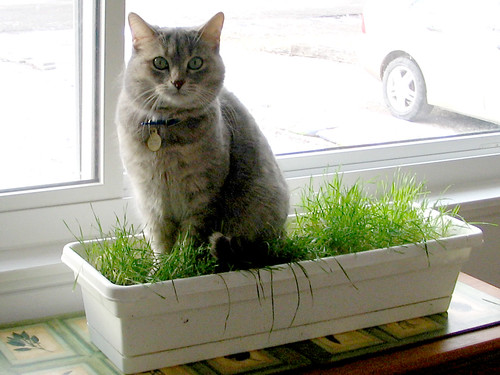
...for growing cat grass indoors! James and Fiona may have differing dispositions and diverging views on many key issues, but they have the exact same thoughts about cat grass.
They like it so much, they even posed for the photos! (And if you live with cats, you know how significant that is.)
I've seen cat grass both as live plants and as seeds at various shops and online. I grow mine from oat and wheat seeds I get from an animal feed store. They're used to selling huge quantities, so the pound I buy of each seed type ends up costing pennies or often just being given to me. I started buying it this way when I was tending the cat garden and I needed lots of seeds.
If you'll be taking part in my seed swap, I'll be adding multiple packets with these seeds to the swap!
The seeds need very little light to germinate and are up in only a few days. You have to keep the grass cut back or the blades get too tall and bristly over time. As winter drags on, the grass does get ratty (especially as Fiona sits in the container), so I just reseed afresh.
They like it so much, they even posed for the photos! (And if you live with cats, you know how significant that is.)I've seen cat grass both as live plants and as seeds at various shops and online. I grow mine from oat and wheat seeds I get from an animal feed store. They're used to selling huge quantities, so the pound I buy of each seed type ends up costing pennies or often just being given to me. I started buying it this way when I was tending the cat garden and I needed lots of seeds.
If you'll be taking part in my seed swap, I'll be adding multiple packets with these seeds to the swap!
The seeds need very little light to germinate and are up in only a few days. You have to keep the grass cut back or the blades get too tall and bristly over time. As winter drags on, the grass does get ratty (especially as Fiona sits in the container), so I just reseed afresh.
Labels:
cat garden,
cat gardening,
cats,
cheap,
seeds
Friday, September 11, 2009
Save Your Seeds for Snail-Mail Seed Swap!
Save, save, save ~ Save, save, saveSave your seeds ~ Save your seeds
You can do it! (Sing to the tune of Shake Your Booty!❀)
As the temperatures drop and the days get shorter, do not despair! There's still a lot to do in the garden, and saving your seeds is a great way to save money and get more plants! Trading seeds with other gardeners is even more fun! In January (in time for us winter seed sowers), I'll host my second annual round-robin snail-mail seed swap.
I'll post official directions and sign-up instructions in December, but start collecting seeds now. For a preview, check out last year's instructions.
❀Yes, I know it's a terrible ear worm. I apologize but I think I'm a bit high on bathroom cleaner fumes, and OK, I'll just say it, I like some disco. Not so much this song, but it just fits! But please don't let my poor taste in music prevent you from participating in the swap! It was a hoot last year.
Monday, May 25, 2009
Mish-Mash Memorial Monday
Happy Memorial Day! And lest you think I'm getting in a rut with Mish-Mash Monday, note that today it's Mish-Mash Memorial Monday. Ha! Well, let's get to it.
Monday Maths
I just love Esther's Monday Maths, and I've been inspired to do a second one myself. I didn't write a poem, but hopefully that's offset by the fact that I actually drew something. Esther told me, and I quote, "Not being able to draw is never a reason for not drawing!" So there you go! Crayon is definitely my medium.
You Really Are Priceless!
As Monday Maths tries to convey, I'm very grateful for all the great people I've met through gardening, both in real life and online. You guys are the best! Gardeners love to share and I'm so thankful for all the plants I've gotten from local friends over the years, and recently from my blogging friends! As mentioned in another post, Shady Gardener sent me some Virginia bluebells.
But it's not just plants, but camaraderie we gardeners share. I got to know two of my closest friends IRL through the master gardener program and I've enjoyed getting to know so many of you online. I love getting and leaving comments and I enjoyed meeting a few of you already, and I'm looking forward to meeting more of you at SF. I truly consider you friends, who pick me up and share their lives, gardening and otherwise.
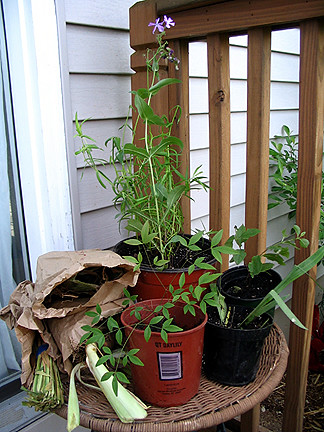
Last week, I got two packages in the mail, one from Gail in TN and one from Randy in AL. Here are the contents of both packages, waiting to be planted. Gail sent Phlox pilosa (also known as PPPP), Penstemon X, and Iris cristata. Randy sent two very cute baby shrubs: a nandina which I had oohed and aahed over in his blog and a sweet mock orange (Philadelphus coronarius), plus Crocosmia 'Firefly' and a bunch of bearded iris rhizomes, including 'Beverly Sills,' my first ever named iris. I know!
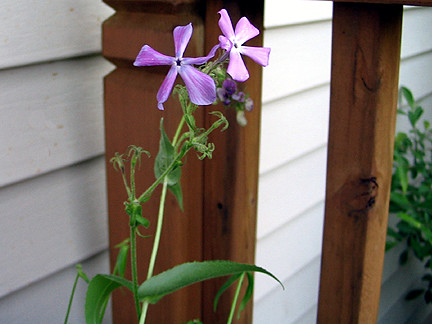
Here is PPPP close-up, with Penstemon X in the background.
And here are the sweet mock orange (left) and the nandina. Noogies times 2! (In case you're wondering, nandina is hardy to zone 6 and I'm zone 5b, but I'll be taking it inside over winter for some years to come.)
I hope my Monday Maths drawing is good enough for Gail to pick out her PPPP and for Randy to find his nandina! And thanks so much to both of you for sharing your plants with me!
I also got three offers from my English garden friends to mail me tea, based on another post, which was so nice and unexpected! Thanks so much in advance!
In Bud and In Bloom
I still have a lot more plants thinking of blooming than I have actual blooms.
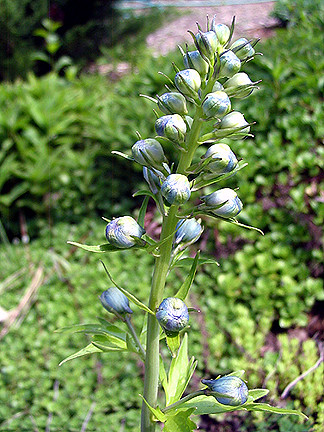
I bought a few perennials in 4-inch pots a few weeks back at a really good price. I wasn't expecting them to bloom this year, and yet this delphinium has buds already...
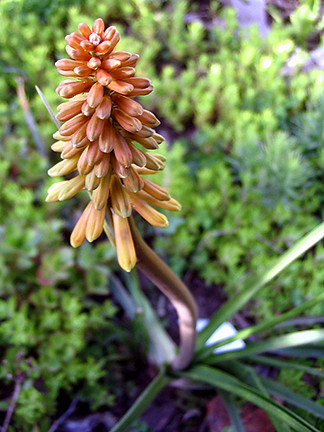
...as does this red hot poker. I love how its buds and foliage look together--sort of like a yucca, even! I even love its curving stem, stretching up behind some evergreen shrubs for the light.
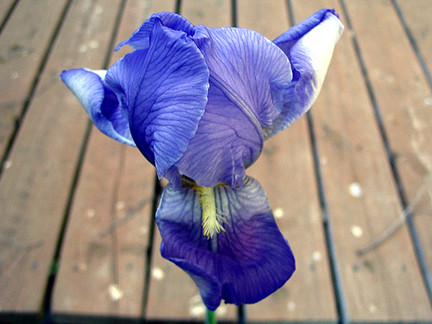
On May 21, my first iris was getting ready to open. I love how the yellow beard peeks out here.
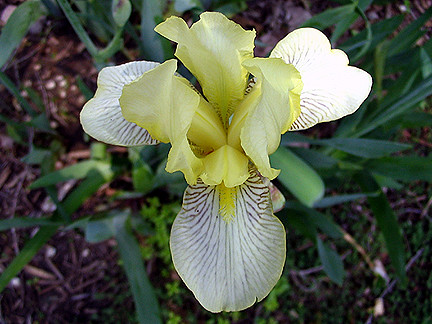
Today two other irises are open, both this pale yellow color, but most of my irises still have buds.
A few centaurea have popped up here and there in the garden. I love how they inserted themselves in the middle of these rudbeckia.
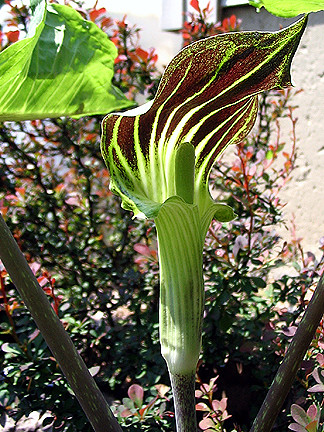
One of my favorite currently-blooming plants is Jack in the pulpit. You'll have to trust me when I tell you this location is sunny only for about 2 hours a day. I think this is what they mean by backlit photography! :)
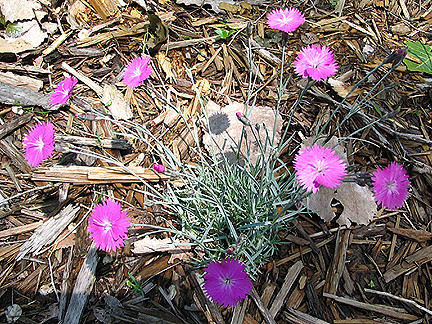
I have five little clumps of pinks, three of which are blooming. I got these free, along with some sedum, as they were left over after I helped plant a green roof in downtown Ann Arbor last May. I even went back last November to get some snow photos of the green roof, but I have yet to post about this!
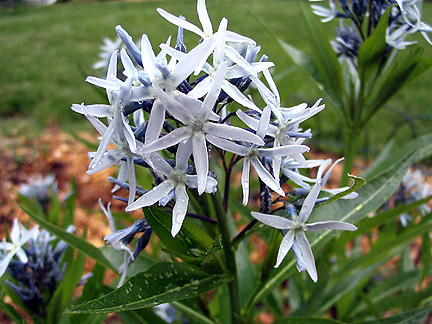
This amsonia is a really cool shade of very pale blue.
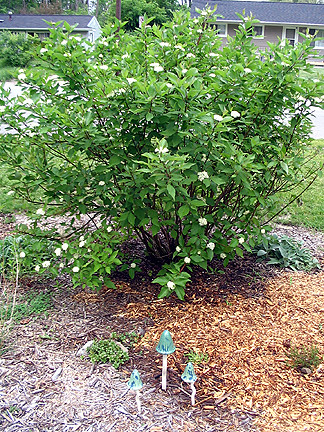
I keep meaning to move this allium but forget where it is in fall. I love the way it's hiding in the viburnum foliage (note Burny also has flower buds!).
This shot doesn't really convey the beauty of this red twig dogwood, which I bought on deep discount some six years ago as a sad-looking shrub maybe 2.5 feet tall and 1 foot wide. It's now over 6 feet tall and just about as wide and it's blooming its heart out. (Linda, that's the thyme we got from the ChiBot last July to the bottom right there. I've moved it twice.)
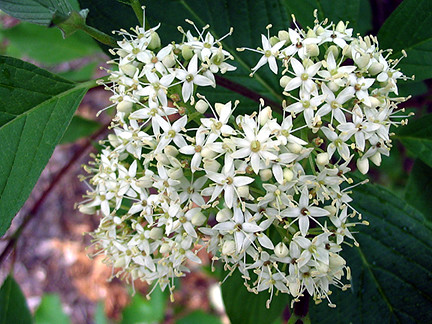
Here is a red twig dogwood flower cluster up close. Awwwww!
Some Anemone are still blooming, but a few are done. I love how their seedheads look. I never realized they turned oblong, like coneflowers do.
Wildlife
I love how this squirrel is just standing here, like that's the most normal position for a squirrel, ever.
And she posed for me here, too, though my macro feature wanted to focus on the tree bark.
And can you find the American toad in this photo? I knew you could!
I love the silhouette of an ant (not The Iron Ant, incidentally) on the peony bud.
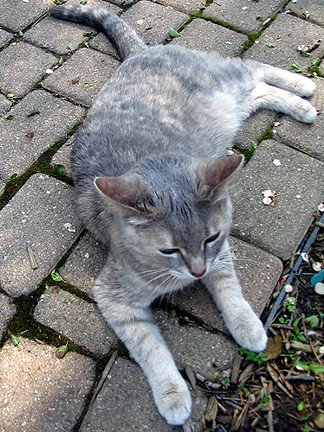
Finally, Fiona says that if you missed James' birthday post yesterday, please stop by to wish him belated greetings. She also wants to assure you that while she is no longer a stray, she can still fend for herself and can unilaterally be considered wild. (IMHO, she's a sweet housecat, but no one asked me!) And in case you're wondering, and even if you're not, Fiona's nicknames will be covered on her birthday, July 4.
Monday Maths
I just love Esther's Monday Maths, and I've been inspired to do a second one myself. I didn't write a poem, but hopefully that's offset by the fact that I actually drew something. Esther told me, and I quote, "Not being able to draw is never a reason for not drawing!" So there you go! Crayon is definitely my medium.You Really Are Priceless!
As Monday Maths tries to convey, I'm very grateful for all the great people I've met through gardening, both in real life and online. You guys are the best! Gardeners love to share and I'm so thankful for all the plants I've gotten from local friends over the years, and recently from my blogging friends! As mentioned in another post, Shady Gardener sent me some Virginia bluebells.
But it's not just plants, but camaraderie we gardeners share. I got to know two of my closest friends IRL through the master gardener program and I've enjoyed getting to know so many of you online. I love getting and leaving comments and I enjoyed meeting a few of you already, and I'm looking forward to meeting more of you at SF. I truly consider you friends, who pick me up and share their lives, gardening and otherwise.
Last week, I got two packages in the mail, one from Gail in TN and one from Randy in AL. Here are the contents of both packages, waiting to be planted. Gail sent Phlox pilosa (also known as PPPP), Penstemon X, and Iris cristata. Randy sent two very cute baby shrubs: a nandina which I had oohed and aahed over in his blog and a sweet mock orange (Philadelphus coronarius), plus Crocosmia 'Firefly' and a bunch of bearded iris rhizomes, including 'Beverly Sills,' my first ever named iris. I know!
Here is PPPP close-up, with Penstemon X in the background.
And here are the sweet mock orange (left) and the nandina. Noogies times 2! (In case you're wondering, nandina is hardy to zone 6 and I'm zone 5b, but I'll be taking it inside over winter for some years to come.)I hope my Monday Maths drawing is good enough for Gail to pick out her PPPP and for Randy to find his nandina! And thanks so much to both of you for sharing your plants with me!
I also got three offers from my English garden friends to mail me tea, based on another post, which was so nice and unexpected! Thanks so much in advance!
In Bud and In Bloom
I still have a lot more plants thinking of blooming than I have actual blooms.
I bought a few perennials in 4-inch pots a few weeks back at a really good price. I wasn't expecting them to bloom this year, and yet this delphinium has buds already...
...as does this red hot poker. I love how its buds and foliage look together--sort of like a yucca, even! I even love its curving stem, stretching up behind some evergreen shrubs for the light.
On May 21, my first iris was getting ready to open. I love how the yellow beard peeks out here.
Today two other irises are open, both this pale yellow color, but most of my irises still have buds.
A few centaurea have popped up here and there in the garden. I love how they inserted themselves in the middle of these rudbeckia.
One of my favorite currently-blooming plants is Jack in the pulpit. You'll have to trust me when I tell you this location is sunny only for about 2 hours a day. I think this is what they mean by backlit photography! :)
I have five little clumps of pinks, three of which are blooming. I got these free, along with some sedum, as they were left over after I helped plant a green roof in downtown Ann Arbor last May. I even went back last November to get some snow photos of the green roof, but I have yet to post about this!
This amsonia is a really cool shade of very pale blue.
I keep meaning to move this allium but forget where it is in fall. I love the way it's hiding in the viburnum foliage (note Burny also has flower buds!).
This shot doesn't really convey the beauty of this red twig dogwood, which I bought on deep discount some six years ago as a sad-looking shrub maybe 2.5 feet tall and 1 foot wide. It's now over 6 feet tall and just about as wide and it's blooming its heart out. (Linda, that's the thyme we got from the ChiBot last July to the bottom right there. I've moved it twice.)
Here is a red twig dogwood flower cluster up close. Awwwww!
Some Anemone are still blooming, but a few are done. I love how their seedheads look. I never realized they turned oblong, like coneflowers do.Wildlife
I love how this squirrel is just standing here, like that's the most normal position for a squirrel, ever.
And she posed for me here, too, though my macro feature wanted to focus on the tree bark.
And can you find the American toad in this photo? I knew you could!
I love the silhouette of an ant (not The Iron Ant, incidentally) on the peony bud.
Finally, Fiona says that if you missed James' birthday post yesterday, please stop by to wish him belated greetings. She also wants to assure you that while she is no longer a stray, she can still fend for herself and can unilaterally be considered wild. (IMHO, she's a sweet housecat, but no one asked me!) And in case you're wondering, and even if you're not, Fiona's nicknames will be covered on her birthday, July 4.
Labels:
blooms,
cats,
cheap,
frog/toad,
green roofs,
master gardener volunteer,
Mish-Mash Monday,
native plants,
nature,
squirrels
Subscribe to:
Posts (Atom)