Showing posts with label flowers. Show all posts

Thursday, October 6, 2011

A romp through Shanghai Prairie (part 2)

In my previous post about visiting Shanghai Prairie in Ann Arbor, Michigan, I discussed the background of the restored priaire and showed you some of what's growing there, including grasses and some fall-blooming flowers.

I didn't have the chance to show you everything, so here are some more photos from my visit on September 12, plus tips for how to incorporate these native plants into your own garden.

The prairie has subtle undulating elevations, due to the area previously being strip-mined. This means both plants that prefer wet soil (lower areas) and plants requiring very dry soil (higher areas) grow there.

Gray or old-field goldenrod (Solidago nemoralis) has green-gray fuzzy leaves and likes dry or well-drained soils. It doesn't mind clay soil, does well on slopes, and gets about two and a half feet tall.

Stiff or stiff-leaved goldenrod (Oligoneuron rigidum, formerly known as Solidago rigida) can get up to 5 feet tall. It prefers full sun and dry soil. The foliage is pale green with thick leaves extending perpendicular to the stem, and the flowers are a bit more showy than other goldenrods with more of a poofy shape than upright stalks.  
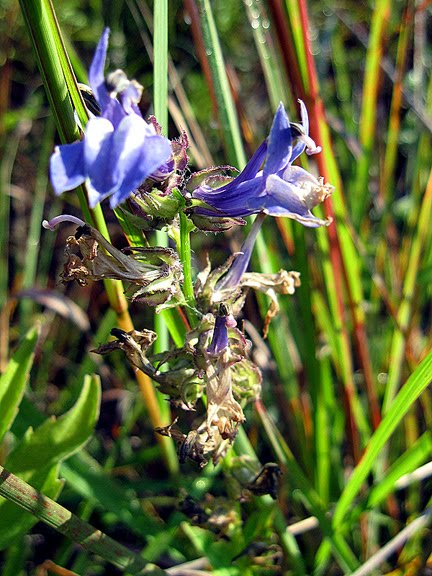
 
Great blue lobelia (Lobelia siphilitica) prefers moist or wet soil and part sun. It can handle full sun if it's in  extremely wet soil. It can reach 3 feet and attracts bumble bees. I like its blue flowers in the late season when most other blooms are yellow, pink, or white (in my garden, anyway). Alas, my soil is not wet enough to grow it, but if you have a bog or wetland, or are simply willing to water frequently, give it a try. Great blue lobelia is endangered in Massachusetts.

Nodding ladies'-tresses (Spiranthes cernua) is a native orchid. It grows only 8 to 12 inches tall, which is fairly unusual among the many taller plants in a prairie, and it's easy to miss it if you aren't specifically looking for it. It grows in consistently wet soil and prefers full sun.

Even this bad photo of American bittersweet (Celastrus scandens) will help you ID this native woody vine in comparison to the invasive variety, oriental bittersweet (Celastrus orbiculatus). Oriental bittersweet has flowers/berries in clusters of 2-3 in the leaf axils all along the vine, whereas American bittersweet has flowers/berries in clusters of 6 or more solely at the ends of the vine. The ripe berries of both are red, but the capsules, or protective covers over the berries, are yellow for oriental bittersweet and orange/red for American bittersweet.

Purple loosestrife (Lythrum salicaria) is an invasive plant that outcompetes other species in the prairie fen. Fortunately, it hasn't spread too much at Shanghai Prairie, with only this one major clump. (Random, unidentifiable human shown only for size reference.)

Like many other invasive plants, purple loosestrife is a "nitrogen fixer" that alters soil composition by releasing nitrogen and raising soil nutrents. There are instances where this is a good thing, like farmers planting cover crops (such as red clover and winter wheat) and tilling them into the soil before they go to seed to improve the soil for growing food crops. However, in prairies and other natural habitats, nitrogen is a bad thing. Native plants generally require poor soil conditions and do not grow as well in nitrogen-enhanced soil. (So if you grow prairie natives in your garden, it is not only not necessary, but also detrimental, to fertilize them!)

Lol, I'm suddenly picturing myself in a booth labeled "Plant Advice, 5 Cents." Ha!

Also fortunate for Shanghai Prairie is that purple loosetrife beetles (Galerucella spp.) are present. They eat  the leaves of purple loosetrife and help keep the population in check. The beetle was approved by the USDA in 1992 as a biological control, after research confirmed its host specificity at numerous test sites. In other words, it was determined the beetles only eat purple loosestrife leaves, not those of other plants, not even other (non-invasive) loosestrifes. 

The beetle has been released at trial sites in Michigan since 1994. They were not released into the Shanghai Prairie, but appeared on their own from nearby sites.

I can almost imagine a bunny holding one of these rabbit tobacco (Gnaphalium obtusifolium) flowers and smoking it like a cigar, except that in my mind, rabbits wouldn't smoke! The plant is sometimes also called sweet everlasting and it is supposedly fragrant (smelling like maple syrup), but I didn't bend down to smell it. The plant gets up to two feet tall and likes dry or well-drained soil.

Smooth or smooth-leaf aster, Symphyotrichum laeve (formerly known as Aster laevis; remember, the aster family got a huge naming overhaul!) prefers full sun but can handle some shade. It gets 2-3 feet tall and prefers dry to moderately dry soil. It does not mind clay. Its leaves are smoother, with an almost waxy feel, than those of a similar aster ...

...the New England aster (Symphyotrichum novae-angliae). The New England aster also gets taller, to 4 feet and above, and its flowers tend to be darker purple, than smooth aster. It also prefers full sun, but can handle some shade, and seems to deal with different kinds of soils. If you have these in ornamental beds with shorter plants, and want more uniform heights, you can cut them back on July 4 the same time you cut back mums. Mine self sow here and there and I like them towering over other plants.

The humble-looking Virginia snakeroot (Aristolochia serpentaria) is actually a rare and threatened species in Michigan, present in only two counties. It is an indicator species of a high quality oak woods. This one was growing in the wooded hillside near Shanghai Prairie. You cannot remove threatened species from their natural locations.

Hope you enjoyed your armchair romp through a prairie fen! If you are interested in seeing the prairie in person, you can attend upcoming volunteer workdays to help remove woody invasives:
- Sunday, October 16, noon to 4:00 p.m
- Saturday, October 22, 9:00 a.m. to 1:00 p.m.
Please wear long pants and sturdy closed toe shoes. To register and get directions (on campus of St. Joe Mercy Hospital), call volunteer steward Aunita Erskine at 734.668.6354 or email aunitafl at umich dot edu.

Wednesday, September 28, 2011

A Grand Day Out at Ball Horticultural Co.

Last month I enjoyed touring the gardens at Ball Horticultural Co. in West Chicago, Illinois, with Mr. Brown Thumb and Garden Girl.

Ball was started in 1905 by George J. Ball and remains a family company today. Ball breeds and distributes ornamental plants to wholesalers. The Wave® petunia is one of its many plant introductions. Through its Burpee Home Gardens arm, it also offers vegetable seeds and plants.

The grounds showcase new and recently introduced varieties of annuals, perennials, herbs, and vegetables. 

I was dazzled by the colors...

textures... 

water features...

plant structures... (also check out the tomatoes in the foreground!)

peacefulness...

and abundance of insects! The bee looks so happy on the Gaillardia 'Mesa Yellow'. I also love the seed heads!

I took way too many photos, so I'm just going to share plants or colors that make me think of fall. The rows of Coleus in an earlier photo really set the mood!

I love the leaf margins, color, and texture of this Begonia 'Fannie Moser.'

I love black plants and this ornamental pepper 'Black Pearl' is so dark the photo almost looks black and white.

I love the colors of these cute little Calibrachoa Minifamous™ 'Apricot Red Eye Evol.'

The flower color of this striking Celosia 'Intenz' screams hot summer, but the purple tinge in the foliage makes me think of fall.

This vibrant Echinacea 'Sombrero Hot Coral' makes my heart sing.

I love the orange tones of this Gaillardia 'Arizona Apricot.'

On the outer edge of the gardens, Ball and ComEd are restoring a prairie habitat. (If you're interested in prairies, check out the restoration of Shanghai Prairie in Ann Arbor, Michigan.)

Many thanks to Katie Rotella of Ball for giving us a guided tour of the gardens, providing us with a free lunch, and hooking me up with a behind-the-scenes tour of Ball's seed processing facility (I'll do a separate post about that). Thanks also to Mr. Brown Thumb for arranging the tour!

Friday, September 16, 2011

A romp through Shanghai Prairie (part 1)

Monday was bright, sunny, and unseasonably warm — a perfect day to romp around in a prairie. My friend Aunita Erskine took me on a tour of Shanghai Prairie in Ann Arbor near St. Joe's Hospital and Washtenaw Community College. She has been spearheading a restoration effort of this prairie for several years. Volunteers have been removing invasive species like buckthorn and autumn olive, and building boardwalks over wet areas.

The prairie covers about 35 acres between railroad tracks and the bend in the Huron River. It's considered a disturbed prairie remnant, with part dry to mesic soil conditions. The wetter part of the ecosystem is a prairie fen.

The prairie is in an area formerly inhabited by the Potawatomi, who called the area the Burnt River District. They regularly burned the area to create open spaces for the animals they hunted to graze. After the federal government bought the land, it was strip-mined for gravel. After that project was abandoned, vegetation returned, but many non-native and aggressive trees and shrubs filled in the space, outcompeting the grasses and prairie flowers. Later, sparks from the railway started little fires that killed the trees, and prairie plants again started to take a foothold.

Everything growing the the prairie today was in the prairie hundreds of years ago. Nothing has been reintroduced. Many prairie plants also make great garden plants.You can integrate native plants into your existing garden or create a new bed just for them.

Big bluestem grass (Andropogon gerardii) is sometimes called turkey foot. It reaches about 8 feet, prefers full sun, and does well in most soil conditions, except sand. It gets red in fall and is named for its green-blue color in spring. The seed head gets tiny yellow flowers which are quite striking in the fall landscape.

The prairie has several glacial erratics of varying sizes, which were washed in with the melting glaciers. Michigan is, by the way, the only state that was 100% covered in glaciers. It also means our soils are very random, from sand to clay to gravel in very short distances, sometimes in one yard.

Little bluestem grass (Schizachyrium scoparium) gets about 3 feet tall and is ideal for the home garden. It gets gorgeous reddish fall color, but is named for its green-blue color in spring. It prefers full sun, and can deal with most soils. It's not wild about clay, but it does OK in my very clay-y soil.

Indian grass (Sorghastrum nutans) looked so gorgeous covered in dew and swaying slightly in the breeze. It can reach 8 feet, but I've generally seen it top out at 6. Later in fall, its foliage turns dark orange/purpley. It is great for the home garden because it grows well in full sun to shade, and it can handle dry ot moist soil conditions.

Prairie dock (Silphium terebinthinaceum) is eaten by dear in the prairie and only the leaves remain. It normally gets 2 to 3-inch yellow flowers on very tall (up to 8 feet) stalks. It needs full sun and can handle moist to dry soil conditions. Give it a bit of space, as the leaves are huge.

Rough blazingstar (Liatris aspera). This grows well in the home garden, prefers full sun, and can handle most soil conditions except sand. It attracts birds and butterflies, and has the coolest looking pink-hued buds (the non-open flowers here are wilted flowers, not buds.)

There's just something about these gray-headed coneflower (Ratibida pinnata) seed heads! The plant gets about 4 feet tall, has yellow flowers with brown centers, prefers full sun, and likes most soil conditions, except sand. 

My absolute favorite things in the entire prairie were these gorgeous spent flowers of round-headed bush clover (Lespedeza capitata). It gets about 4 feet tall and prefers full sun, and mesic (average moisture) to dry soil conditions. The bloom is white.

Boneset (Eupatorium perfoliatum) gets about 3 feet tall and is a nice companion plant to Joe Pye weed. It attracts bees and butterflies, can handle full to part sun, and prefers moist soil. The leaves were used to treat dengue fever.

Heath aster (Symphyotrichum ericoides) is just starting to bloom. It's a wetland indicator species (meaning if you see one in the wild, it means you're in a wetland ecosystem) that gets about 2 feet tall and can also tolerate drier soils. It is resistant to deer browsing. Native Americans used heath asters to bind the structure of sweat lodges and on hot rocks to create herbal steam. This plant is threatened in Tennessee.

Sneezeweed or Helen's flower (Helenium autumnale) is one of my favorite fall flowers. Cultivars are available in burgundy ('Ruby Tuesday'), orange ('Orange Beauty'), and orange and yellow ('Mardi Gras'), but I also love the native yellow flowers. It grows to 4-5 feet tall and prefers full sun and moist soil; it flowers just as well in drier soils, but won't get as tall. Incidentally, it's called sneezeweed not because it causes allergies, but because Native Americans used it as snuff.

I can tell you're getting tired, so we'll break up our jaunt. Next time I'll show more prairie flowers, including a ladies' tresses orchid, as well as Virginia snakeroot, a threatened species growing in the nearby woodland.


Friday, September 2, 2011

Everything's comin' up marigolds

I have cottonwood leaves all over my garden and we've had some deliciously cool nights, so fall is definitely in the air. (We'll just ignore the fact that it's 95°F and super humid today.) I do an awful lot of transplanting in fall and am looking forward to the busy 6-8 weeks ahead of me! It's been so hot this summer that I haven't been in the garden nearly as much as normal.

The beginning of September also means it's time for the monthly SeedGROW post.

I'm really liking the 'Summer Splash' marigolds. The photo on the seed packet shows them as a solid lemon yellow, but in all honesty, I prefer this color.

The plants are super bushy and nearly 2 feet tall, and I only watered them regularly after I first planted them. I really like them along the edge of my veggie bed, and they have helped me fall in love with marigolds again.

My basil 'Italian Cameo' did absolutely marvelously, considering how often I forgot to water it--and it was in a container! I harvested it to make pesto (using this recipe, only I roasted the pine nuts first and added twice the amount of garlic they listed), so it now looks like this. If you would like to see the actual plant and its beautiful leaves, go here.

I hadn't thinned out my lettuce 'Garden Babies' and it was growing too closely together. It's doing much better now with more room.

I'm growing with the SeedGROW project. Thanks to Renee's Garden for the seeds.
placeholder

Monday, August 1, 2011

Growing potatoes in plastic bins

I don't have optimal soil or sun conditions, and a really full garden, so my space for a veggie bed is limited. A few years ago, I started growing vegetables in containers, sneaking them into sunny spots between perennials and shrubs, here and there throughout the garden. I've discovered many vegetables grow well in containers--tomatoes, peppers, zucchini, eggplant, carrots, beets, turnips, squash, and even potatoes. Actually, especially potatoes! Here's how to do it.

First you need potatoes, ideally small ones which are better suited to the confined space of a container.  I select smaller varieties and grow them to maturity (harvesting about a week after the foliage has died back). Another option is to grow full-size potatoes but harvest them early as baby potatoes before they reach full size (about a week or two after flowers form).

Last year I grew 'Bintje' (above). This year I'm growing 'German Butterball,' 'Purple Peruvian,' and 'Red Norland,' all purchased as seed potatoes (the first three from Landreth, the latter from locally-owned Downtown Home and Garden).

Seed potatoes are not actual seeds; they're mature potatoes that we cut up and plant. If you get your seed potatoes a month or so before planting, store them in a cool, dry, dark place at about 50 degrees. (If you're storing potatoes throughout the winter, requirements are different. I'll write about that in fall.)

Some people purposefully wait for their seed potatoes to sprout before planting them. This is called chitting and is achieved by storing the potatoes in a dry place at room temperature a week or two before planting. Chitting shortens the amount of time it takes the potatoes to sprout and mature. Some of my potatoes chitted accidentally because my storage area wasn't cool enough. I found it a bit difficult to handle and cut the potatoes without breaking off some of the sprouts.

Whether or not your eyes have sprouted, cut the seed potatoes into pieces so there are three eyes (or buds) per piece. Note: Dark potatoes like this 'Purple Peruvian' will stain your fingers, but it washes off easily.

You can use any large container, provided you drill drainage holes into the bottom. I use plastic storage bins because they're lightweight and inexpensive. They're on sale now for back to school and will be again after the holidays. I got the one shown here at a big box for $4 after Christmas.

My bin is 18" deep, 18" wide, and 25" long, and I wouldn't go any smaller than that, especially not in depth. I drilled holes (7/32" bit) along the bottom edges and in parallel rows, lengthwise. You do not need the lid. I move mine around the garden as a weed suppressant.:)

For filler, I like a 70/30 combo of compost and a good soil mix. The City of Ann Arbor gives out free compost in spring, so I load up there. You can adjust the ratio for your own needs. Potatoes don't need rich soil, but I think they grow much better in a container with it.

Fill your container about a third with your soil/compost mix. Plant each potato piece so it's sitting about an inch from the bottom of the tub and is covered in the rest of the soil. Plant so a cut edge is facing down and the eyes are facing up. I want to tell you I planted the pieces 6 inches apart, but it was likely more like 3 inches. I varied the planting depth a little, to create more space.

Potatoes like full sun, so if you have it, great! If you don't, don't worry. Potatoes are forgiving. Once my trees leaf out, my bin only gets four to six hours of a sun a day and the potatoes did fine.

Here is the bin with the potato pieces planted. This year, I also planted in a potato sack, which my mother wasn't using. The instructions are the same, except you don't need to drill holes because the material is porous, and not as many potatoes fit into it. Otherwise, results were the same.

In-ground potatoes can be planted when soil temperatures reach 45F. I plant mine in the bins at the end of April here is southeastern Michigan, where the last frost date is mid-May.

I water my potatoes once a day, like I would any container. Don't worry if your potatoes don't grow evenly at first. The shorter foliage will catch up in a few weeks.

The heights have evened out now at about 8 inches tall. At this stage, you want to add more soil into the bin, which is the same concept as mounding soil around a plant growing in the ground. Add about 2 inches of soil mix, being careful not to break the stalks.

As the potato stalks grow, keep adding more soil into the bin in stages. This is not an exact science; I add 2 inches each time the foliage gets to be about 8 inches over the soil line. When you've added enough soil to be about 2 inches from the top of the bin, stop filling it. You need at least that amount of clearance so that water has a place to collect without overflowing in heavy rainfalls.

Eventually the potatoes flower (these are 'Peruvian Purple'), bees pollinate, and the potatoes grow.

After about three months, you'll notice that much foliage is still growing, but some has died back. Potatoes are ready to harvest a week or two after the foliage is dried out!

Carefully dig in the areas where foliage has died, leaving the remaining stalks intact. There's nothing I like more than sticking my arm elbow deep in warm earthy compost and rooting around for potatoes. And it's so much easier than digging.

Ta da! My first potato of 2011, a 'Red Norland,' harvested on July 27. They are so good eaten right after harvesting--I ate this one raw, like an apple.

I'm going to do a second planting in the next few days, as soon as I harvest everything currently in the bin. I'm not sure if there's enough time for a second harvest, but I'm going to see what happens. Three months from now will be Halloween. Since potatoes can handle some cold, I'm hoping they will finish by then. I'll let you know.

Another advantage to growing in a bin is you don't have to worry about crop rotation. I dump the compost/soil mix onto my veggie bed at the end of the season, wash the container with a solution of 9 parts water to 1 part bleach, and fill it with fresh soil next year. I can use the same container over and over again, and I save some potatoes to start next year, too.