I don't have optimal soil or sun conditions, and a really full garden, so my space for a veggie bed is limited. A few years ago, I started growing vegetables in containers, sneaking them into sunny spots between perennials and shrubs, here and there throughout the garden. I've discovered many vegetables grow well in containers--tomatoes, peppers, zucchini, eggplant, carrots, beets, turnips, squash, and even potatoes. Actually, especially potatoes! Here's how to do it.
First you need potatoes, ideally small ones which are better suited to the confined space of a container. I select smaller varieties and grow them to maturity (harvesting about a week after the foliage has died back). Another option is to grow full-size potatoes but harvest them early as baby potatoes before they reach full size (about a week or two after flowers form).
Last year I grew 'Bintje' (above). This year I'm growing 'German Butterball,' 'Purple Peruvian,' and 'Red Norland,' all purchased as seed potatoes (the first three from Landreth, the latter from locally-owned Downtown Home and Garden).
Seed potatoes are not actual seeds; they're mature potatoes that we cut up and plant. If you get your seed potatoes a month or so before planting, store them in a cool, dry, dark place at about 50 degrees. (If you're storing potatoes throughout the winter, requirements are different. I'll write about that in fall.)
Some people purposefully wait for their seed potatoes to sprout before planting them. This is called chitting and is achieved by storing the potatoes in a dry place at room temperature a week or two before planting. Chitting shortens the amount of time it takes the potatoes to sprout and mature. Some of my potatoes chitted accidentally because my storage area wasn't cool enough. I found it a bit difficult to handle and cut the potatoes without breaking off some of the sprouts.
Whether or not your eyes have sprouted, cut the seed potatoes into pieces so there are three eyes (or buds) per piece. Note: Dark potatoes like this 'Purple Peruvian' will stain your fingers, but it washes off easily.
You can use any large container, provided you drill drainage holes into the bottom. I use plastic storage bins because they're lightweight and inexpensive. They're on sale now for back to school and will be again after the holidays. I got the one shown here at a big box for $4 after Christmas.
My bin is 18" deep, 18" wide, and 25" long, and I wouldn't go any smaller than that, especially not in depth. I drilled holes (7/32" bit) along the bottom edges and in parallel rows, lengthwise. You do not need the lid. I move mine around the garden as a weed suppressant.:)
For filler, I like a 70/30 combo of compost and a good soil mix. The City of Ann Arbor gives out free compost in spring, so I load up there. You can adjust the ratio for your own needs. Potatoes don't need rich soil, but I think they grow much better in a container with it.
Fill your container about a third with your soil/compost mix. Plant each potato piece so it's sitting about an inch from the bottom of the tub and is covered in the rest of the soil. Plant so a cut edge is facing down and the eyes are facing up. I want to tell you I planted the pieces 6 inches apart, but it was likely more like 3 inches. I varied the planting depth a little, to create more space.
Potatoes like full sun, so if you have it, great! If you don't, don't worry. Potatoes are forgiving. Once my trees leaf out, my bin only gets four to six hours of a sun a day and the potatoes did fine.
Here is the bin with the potato pieces planted. This year, I also planted in a potato sack, which my mother wasn't using. The instructions are the same, except you don't need to drill holes because the material is porous, and not as many potatoes fit into it. Otherwise, results were the same.
In-ground potatoes can be planted when soil temperatures reach 45F. I plant mine in the bins at the end of April here is southeastern Michigan, where the last frost date is mid-May.
I water my potatoes once a day, like I would any container. Don't worry if your potatoes don't grow evenly at first. The shorter foliage will catch up in a few weeks.
The heights have evened out now at about 8 inches tall. At this stage, you want to add more soil into the bin, which is the same concept as mounding soil around a plant growing in the ground. Add about 2 inches of soil mix, being careful not to break the stalks.
As the potato stalks grow, keep adding more soil into the bin in stages. This is not an exact science; I add 2 inches each time the foliage gets to be about 8 inches over the soil line. When you've added enough soil to be about 2 inches from the top of the bin, stop filling it. You need at least that amount of clearance so that water has a place to collect without overflowing in heavy rainfalls.
Eventually the potatoes flower (these are 'Peruvian Purple'), bees pollinate, and the potatoes grow.
After about three months, you'll notice that much foliage is still growing, but some has died back. Potatoes are ready to harvest a week or two after the foliage is dried out!
Carefully dig in the areas where foliage has died, leaving the remaining stalks intact. There's nothing I like more than sticking my arm elbow deep in warm earthy compost and rooting around for potatoes. And it's so much easier than digging.
Ta da! My first potato of 2011, a 'Red Norland,' harvested on July 27. They are so good eaten right after harvesting--I ate this one raw, like an apple.
I'm going to do a second planting in the next few days, as soon as I harvest everything currently in the bin. I'm not sure if there's enough time for a second harvest, but I'm going to see what happens. Three months from now will be Halloween. Since potatoes can handle some cold, I'm hoping they will finish by then. I'll let you know.
Another advantage to growing in a bin is you don't have to worry about crop rotation. I dump the compost/soil mix onto my veggie bed at the end of the season, wash the container with a solution of 9 parts water to 1 part bleach, and fill it with fresh soil next year. I can use the same container over and over again, and I save some potatoes to start next year, too.
Showing posts with label cats. Show all posts
Monday, August 1, 2011
Sunday, February 6, 2011
This & That, Over There
Ohai! Here are some things I've been talking about at my annarbor.com gardening blog:~ Make your own suet cakes for birds
~ Survive the long winter as a gardener
~ Learn how climate change will affect our gardens
~ Rebloom your amaryllis in six easy steps
~ Try something new in your garden this year ('cuz 2011 is gonna bring it!)
Thanks for all your wonderful comments on my last post. I'm trying to keep the blog alive, thanks to some ideas many of you have given me.
This photo is gratuitous, but if you're interested in growing grass indoors for your cats, it's entirely cheap and easy, and cats love it.
Labels:
cats,
I'm baaaack,
wildlife,
winter
Tuesday, July 20, 2010
July Garden Blooms
You might think this is five days late, but really it's 26 days early (holla!) for Garden Bloggers' Bloom Day. This gorgeous Rocky Mountain beeplant (Cleome serrulata) came in a Rocky Mountain Native Wildflower seed packet from BBB Seeds. (It gets the coolest legumey-/beany-looking seed pods.)
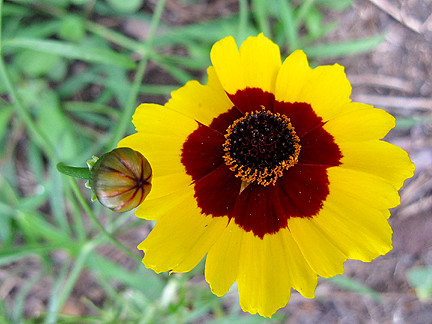
...as did this noogie cute Coreopsis tinctoria--I mean, even the bud has gorgeous color.
A little splash of color.
...and close-up.
My 'Uchiki Kuri' squash is just wonderful on many levels. Its bright yellow flowers are so sunny and friendly...
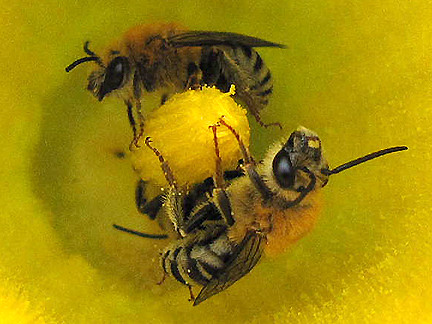
... and attract many busy pollinators (look at the hind legs, noogie!).
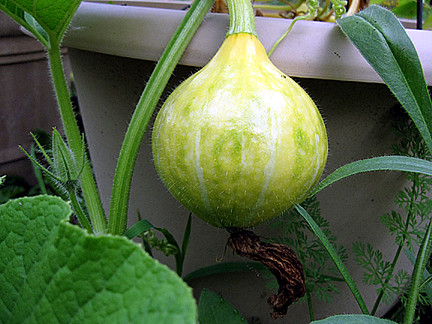
...and, oh yeah, it has fruit, too.
My first rose ever 'Golden Wings' is doing well, despite being in my care. Thanks, Nancy Lindley, for the recommendation.
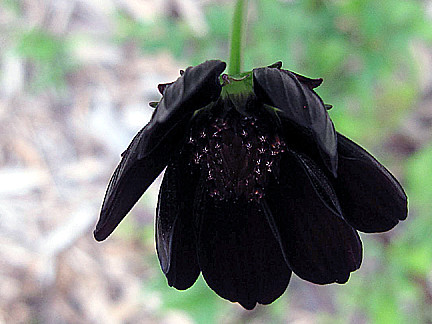
The chocolate cosmos buds are nearly black (!)...
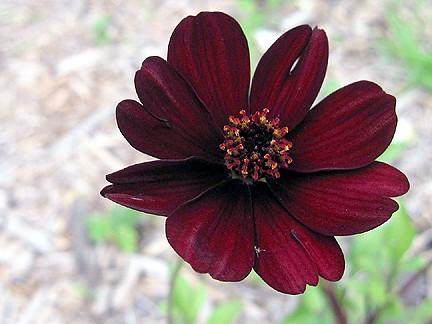
...and open up a warm reddish brown.
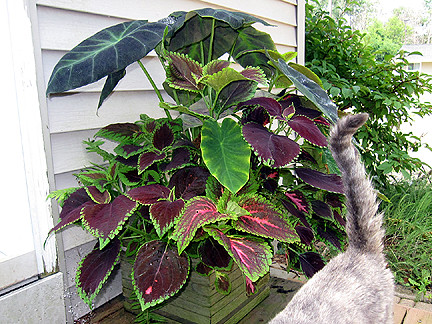
The planter on my north-facing side porch (the only non-veggie container I have) is looking really good. I planted those Coleus from seed! The elephant ears (Colocasia 'Illustris' circa 1902 from Ann Arbor's Old House Gardens) come in the house over the winter, and ferns I have up the ying yang and treat as annuals. Bizi doesn't normally photobomb (!) my shots but she gives a good size reference.
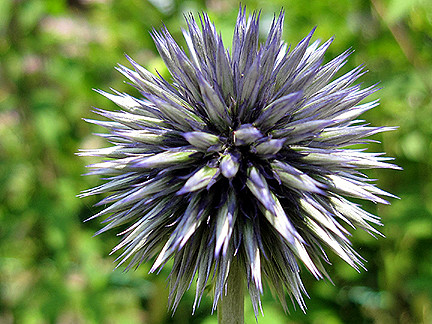
This Echinops reminds me so much of Chihuly's Blue Moon at Meijer Gardens.
The bud of this cup plant (Silphium perfoliatum) is just so so sweet all tucked up and ready to rumble. The plant gets 6-7 feet tall and will have little yellow flowers. Mine is planted entirely in the wrong location (not enough sun, too dry) but it gets to over 5 feet. (I mean to move it every year and somehow never have.)
Cup plant has a square stem that shoots up through the leaves, and collects water. Larger insects like bees and butterflies drink from this water, whereas tiny ones get stuck and the plant absorbs them to help it grow. (H/t to Prairie Moon Nursery for the carnivorous bit.)
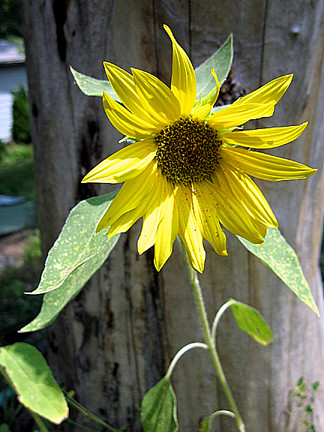
One of the sunflowers that grew from spilled birdseed.
I have three rose of Sharons, two white and one purple, along the bed next to my neighbor's driveway. I got them as tiny sticks in 2004 from a person in my master gardener class, and now they're at least 6 feet tall.
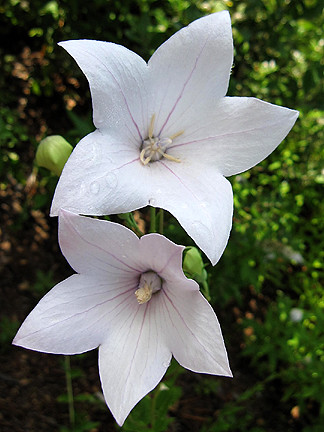
My balloon flowers tend to get very leggy because I forget to cut them back in time.
This huge clump (maybe 10-ft. wide by over 5-ft. tall) of native sunflower (Helianthus divaricatus) is in my south wild bed.
Helianthus divaricatus up close.
Ligularia stenocephala 'The Rocket' does indeed rock it in my east wild bed.
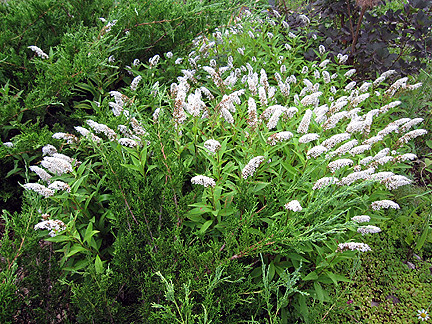
I have two huge clumps of gooseneck loosestrife (Lysimachia clethroides 'Marlene'), which I painstakingly keep in check each spring. I'm not usually one to do garden things painstakingly, but a friend and coworker, who has since passed away, gave me these when I was first starting my garden and I can't bear to get rid of them entirely. (I have no idea what the real cultivar is, I call them Marlene in her honor.)
I have tons of clumps of Rudbeckia, even in shady locations.
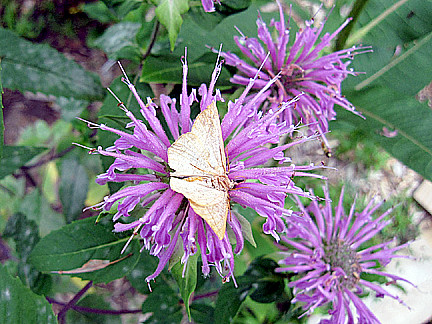
A few large clumps of native bee balm (Monarda fistulosa)...
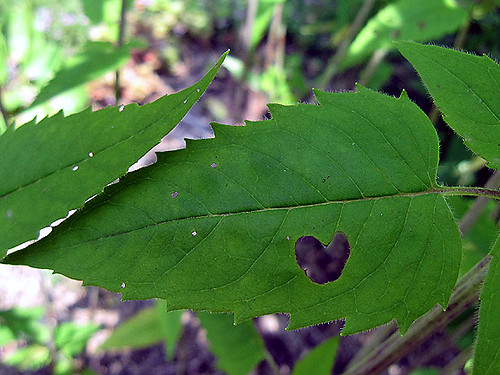
I found this heart-shaped chomp in the bee balm leaf and immediately thought of Katie.
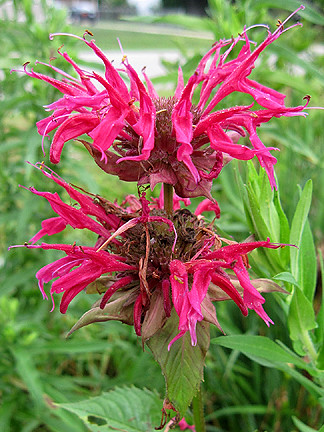
A few cultivar bee balms (Monarda didyma) have self-seeded where they want to go.
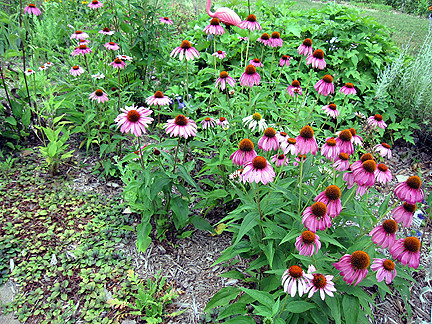
Many clumps of Echinacea, including this big one (I was envious of Rose's clump before realizing I have my own, lol!)
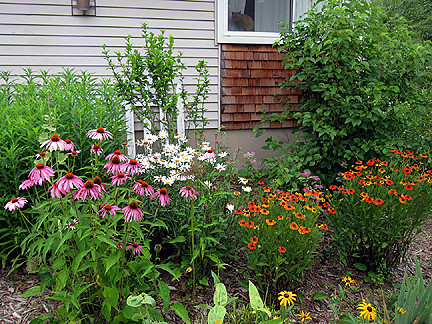
Front of the house, looking south. Yes, friends, things are looking a little wild at Garden Faerie's Musings this year.
I love the bright fuchsia of this swamp milkeeed (Asclepias incarnata)... and I love that Asclepias is a public way of saying ass...

And check out this cute red milkweed beetle on, amazingly enough, my milkweed (Asclepias syriaca)--thanks Lisa for the bug ID in your most recent post! These beetles are immune to the toxins in milkweed but absorb them so they taste yucky to predators, much like monarch and viceroy butterflies.
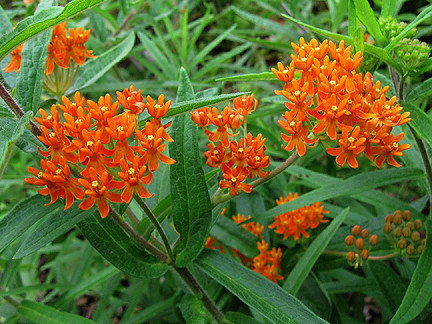
Ah, orange. Glorious orange. Butterfly weed (Asclepias tuberosa) is one of my favorite flowers. Attracts butterflies, my favorite color, no big surprise there.
Yes, it really is 4:30 a.m., this is not a scheduled post. I've been up since 3:00 because Jimi, Radioactive Cat, has been yowling (meowing is too quiet a word) non-stop for about 8 hours. He had radiation (iodine) therapy for a thyroid problem and has to be isolated for two weeks, which he doesn't understand at all. I can only have limited contact with him. We're both a little exhausted! (Dear ASPCA: The photo shows him in the car right after I picked him up from the vet; he is in my spare bedroom now, not a tiny cat carrier! Also, I don't wear fur except what has been shed. Thank you.)
Update: I just got clarification from the regular vet who wasn't there yesterday when Jimi was discharged: I only have to isolate him at night (because he usually sleeps next to me and 8 hours is too much exposure) and if I leave the house (so I can be sure he doesn't use Fiona's litter box or eat her food). It's a good thingI'm a self-unemployed hermit I work from home!
Ah, orange. Glorious orange. Butterfly weed (Asclepias tuberosa) is one of my favorite flowers. Attracts butterflies, my favorite color, no big surprise there.
Yes, it really is 4:30 a.m., this is not a scheduled post. I've been up since 3:00 because Jimi, Radioactive Cat, has been yowling (meowing is too quiet a word) non-stop for about 8 hours. He had radiation (iodine) therapy for a thyroid problem and has to be isolated for two weeks, which he doesn't understand at all. I can only have limited contact with him. We're both a little exhausted! (Dear ASPCA: The photo shows him in the car right after I picked him up from the vet; he is in my spare bedroom now, not a tiny cat carrier! Also, I don't wear fur except what has been shed. Thank you.)Update: I just got clarification from the regular vet who wasn't there yesterday when Jimi was discharged: I only have to isolate him at night (because he usually sleeps next to me and 8 hours is too much exposure) and if I leave the house (so I can be sure he doesn't use Fiona's litter box or eat her food). It's a good thing
Labels:
Ann Arbor,
blooms,
cats,
native plants,
wildflowers
Sunday, July 4, 2010
Keepin' On Keepin' On
It's time for the July post for the Seed GROW Project, organized by Mr. Brown Thumb, with nasturtium seeds (Tropaeolum majus 'Spitfire') donated by Renee's Garden.
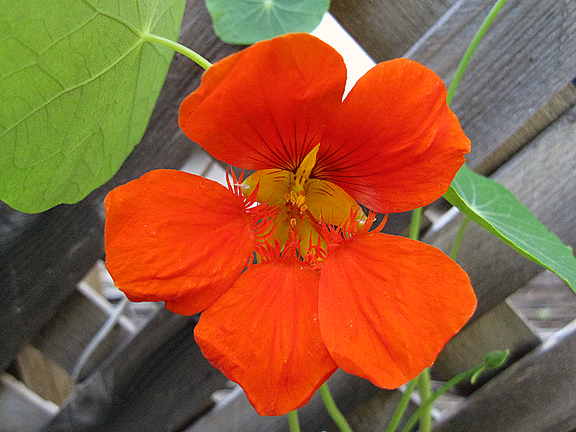
Roooar! I love the fringed end of the petals, which I didn't even see until I downloaded the macro photo!
My three nasturtiums, which I affectionately call nasties, are still going strong. This one started climbing the trellis all on its own.
This one needed a little coaxing. And re-coaxing.
This nasty has the most blooms...
...and should be tall enough to start climbing the corn any day now.
Isn't the corn ('Bantam') tassel cute? Noogie. I only have this one plant, should I be making like a bee and pollinating? I grew it mostly as an experiment to see if it could be winter-sown. The staples in my veggie garden are tomatoes, which I grow in ridiculous quantities, a few hot peppers, and an eggplant. Then I like to mix it up a bit and try different plants each year, even if they aren't the most practical solution for my conditions, just to watch them mature from seed to plant to harvest. As a gardener, I just like to know veggies.
Well, that's it for nasties, but as long as you're still here, let's look at some of the other things growing in my garden. First and foremost, tomatoes! Yes, I have eeny beeny, teeny tiny fruits on five of my (ahem) 18 tomato plants, including 'Big German Pink,' 'Trifele,' and 'Red Short Vine' (all camera-shy).
The biggest is 'Black Russian.'
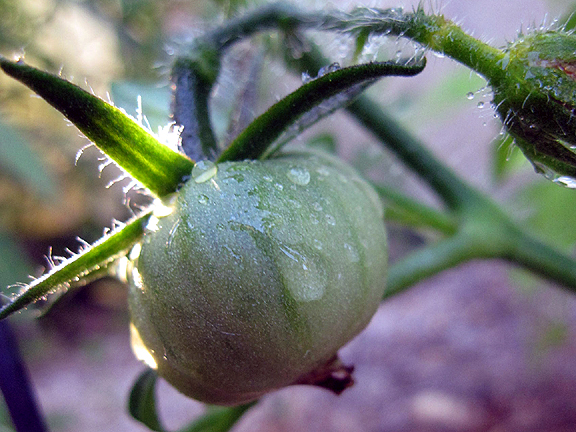
But 'Green Zebra' (which I can't help pronouncing ZEBra not ZEEbra due to certain English people) has twins!
The black cohosh (Actaea (formerly Cimicifuga) racemosa) on the north side of my house is one of my favorite big-impact plants.
It's pretty up close, too. I like how it starts blooming from the bottom up.
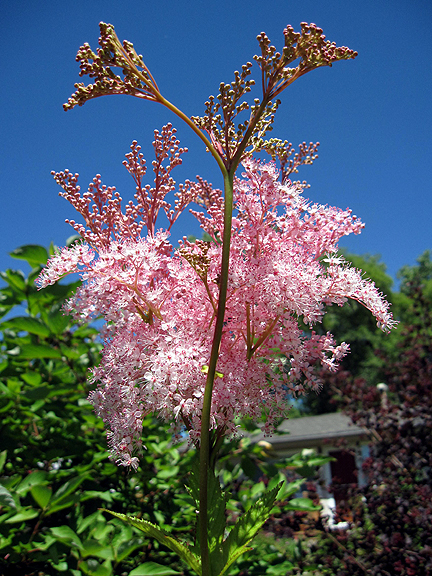
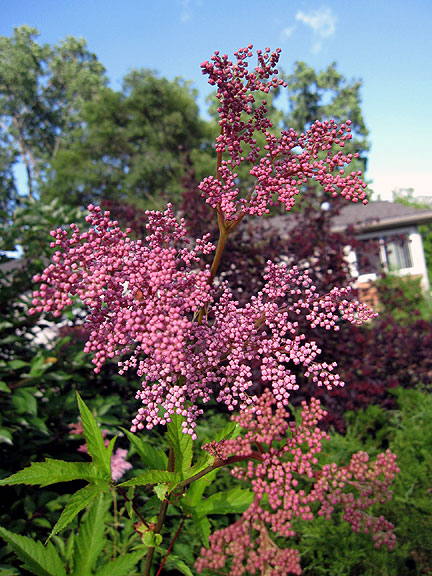
Another big-impact plant (about 6 feet tall) is queen of the prairie (Filipendula rubra). I first saw it during a tour at the 2005 International Master Gardener Conference in Saskatoon, Canada, and knew I had to have it.
I thought the buds looked pretty cool, too.
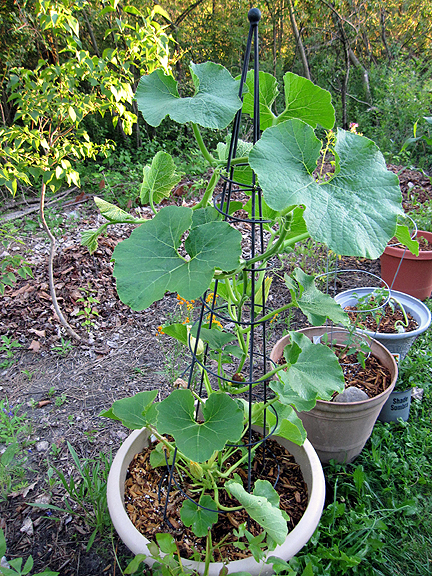
This 'Uchiki Kuri' squash is doing well. I like putting crazy growers in a container because I don't need the optimal amount of fruit. I've successfully grown zucchini and eggplant in containers, too.
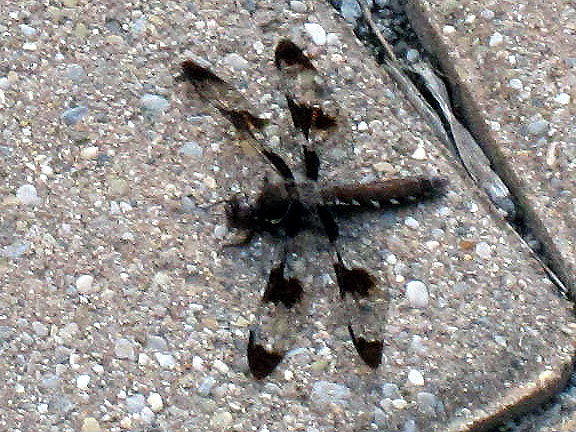
All the rain this spring has been great for the plants, and it also means I've seen tons of these sweet dragonflies in my garden (I live next to a creek)...
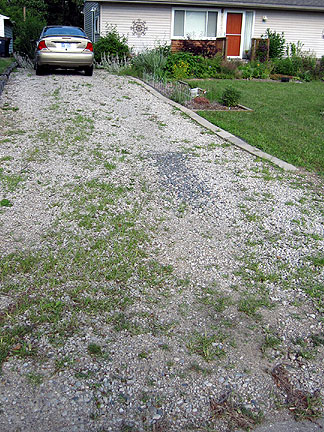
But it also means I'm going to have to mow my driveway (ha!).
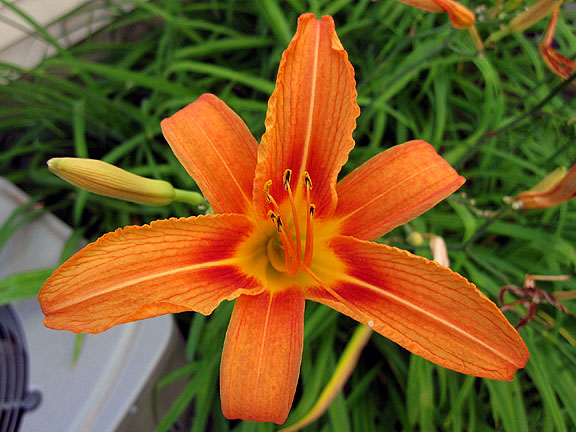
These are the common "ditch" lilies. I love them. I think if we take the time, we can see new things in familiar faces.
Shasta daisies always make me smile. They are in a huge clump, about 5 feet wide and nearly as tall.
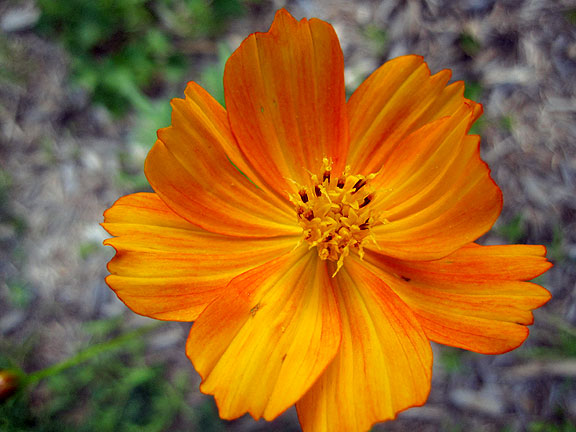
I just love the orange cosmos, which look pretty good next to the chocolate cosmos.
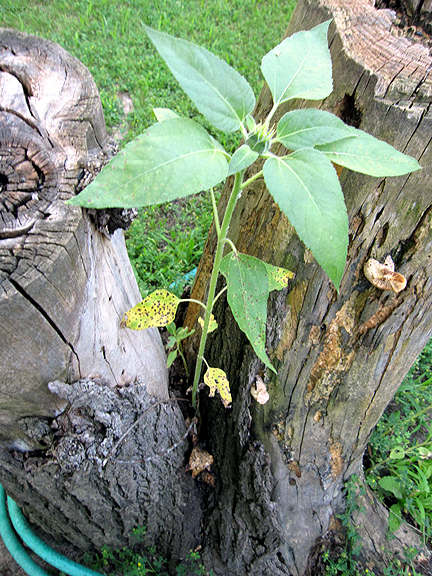
I wasn't surprised a volunteer sunflower was growing in my backyard tree stumps, because I feed the squirrels there in winter.
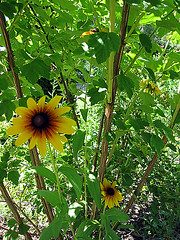
I was, however, amazed to find four sunflowers growing in the front garden in the shaded interior of my ninebark shrub.
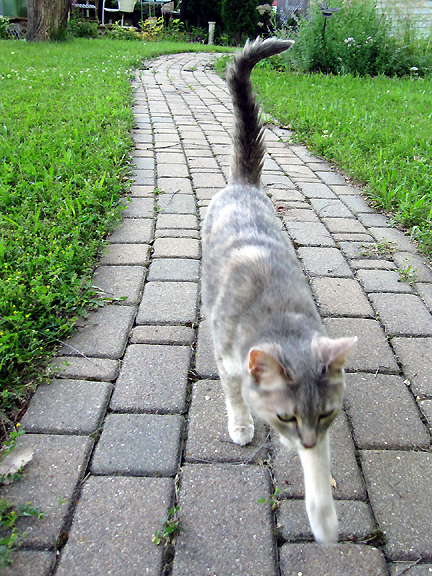
And finally, eight years ago today, Fiona found me. She had been abandoned by her previous family and decided I looked like an easy mark who she could train pretty easily. She is pleased with my ability to provide food, water, and various cat plants, but is amazed at the number of other basic commands I haven't mastered.
I'm growing Nasturtium 'Spitfire' for the GROW project. Thanks to Renee's Garden for the seeds.
Roooar! I love the fringed end of the petals, which I didn't even see until I downloaded the macro photo!
My three nasturtiums, which I affectionately call nasties, are still going strong. This one started climbing the trellis all on its own.
This one needed a little coaxing. And re-coaxing.
This nasty has the most blooms...
...and should be tall enough to start climbing the corn any day now.
Isn't the corn ('Bantam') tassel cute? Noogie. I only have this one plant, should I be making like a bee and pollinating? I grew it mostly as an experiment to see if it could be winter-sown. The staples in my veggie garden are tomatoes, which I grow in ridiculous quantities, a few hot peppers, and an eggplant. Then I like to mix it up a bit and try different plants each year, even if they aren't the most practical solution for my conditions, just to watch them mature from seed to plant to harvest. As a gardener, I just like to know veggies.Well, that's it for nasties, but as long as you're still here, let's look at some of the other things growing in my garden. First and foremost, tomatoes! Yes, I have eeny beeny, teeny tiny fruits on five of my (ahem) 18 tomato plants, including 'Big German Pink,' 'Trifele,' and 'Red Short Vine' (all camera-shy).
The biggest is 'Black Russian.'
But 'Green Zebra' (which I can't help pronouncing ZEBra not ZEEbra due to certain English people) has twins!
The black cohosh (Actaea (formerly Cimicifuga) racemosa) on the north side of my house is one of my favorite big-impact plants.
It's pretty up close, too. I like how it starts blooming from the bottom up.
Another big-impact plant (about 6 feet tall) is queen of the prairie (Filipendula rubra). I first saw it during a tour at the 2005 International Master Gardener Conference in Saskatoon, Canada, and knew I had to have it.
I thought the buds looked pretty cool, too.
This 'Uchiki Kuri' squash is doing well. I like putting crazy growers in a container because I don't need the optimal amount of fruit. I've successfully grown zucchini and eggplant in containers, too.
All the rain this spring has been great for the plants, and it also means I've seen tons of these sweet dragonflies in my garden (I live next to a creek)...
But it also means I'm going to have to mow my driveway (ha!).
These are the common "ditch" lilies. I love them. I think if we take the time, we can see new things in familiar faces.
Shasta daisies always make me smile. They are in a huge clump, about 5 feet wide and nearly as tall.
I just love the orange cosmos, which look pretty good next to the chocolate cosmos.
I wasn't surprised a volunteer sunflower was growing in my backyard tree stumps, because I feed the squirrels there in winter.
I was, however, amazed to find four sunflowers growing in the front garden in the shaded interior of my ninebark shrub.
And finally, eight years ago today, Fiona found me. She had been abandoned by her previous family and decided I looked like an easy mark who she could train pretty easily. She is pleased with my ability to provide food, water, and various cat plants, but is amazed at the number of other basic commands I haven't mastered.I'm growing Nasturtium 'Spitfire' for the GROW project. Thanks to Renee's Garden for the seeds.
Subscribe to:
Posts (Atom)